All posts by Radi

Rinse and Repeat creator speaks out against Twitch after ban

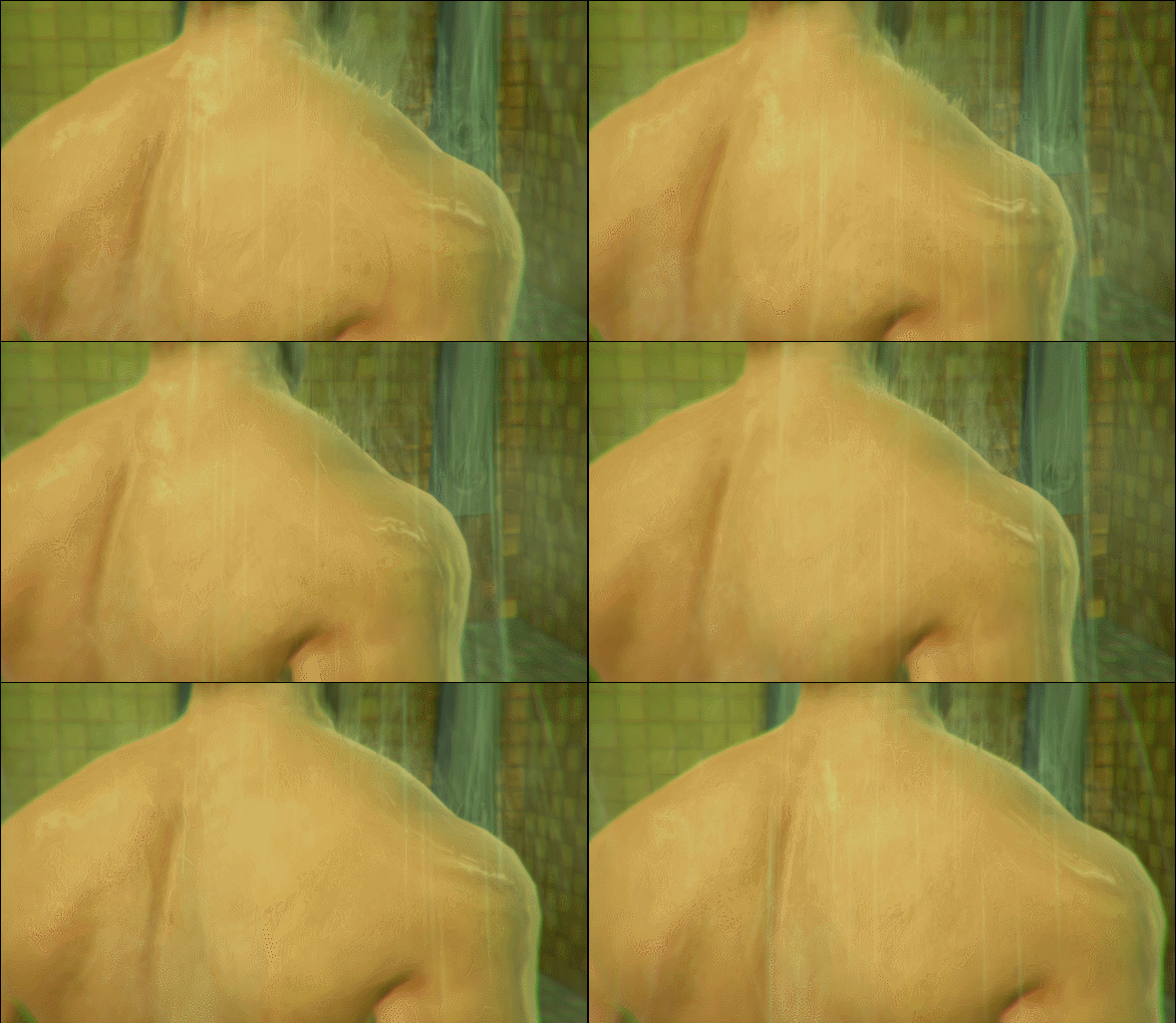
Robert Yang, the developer and scholar behind the locker room-set, playable social commentary Rinse and Repeat, has called a Twitch policy that resulted in his game’s prohibition from the service “fucking disgraceful.”

As he did in a pair of tweets acknowledging the game’s addition to Twitch’s blacklist, he noted in a post sharing his thoughts on the ban that while the censorship is, in a way, “validating,” “the Twitch policy about sex and nudity is shitty… and also really unhealthy for video games as an artform.”

Twitch’s rules of conduct state that “nudity can’t be a core focus or feature” of a streamed game, and Rinse and Repeat’s shower-based gameplay fits that description. Yet Yang feels that the rule “erases the context of the work and ignores how the nudity is presented,” he writes. “Instead [Twitch focuses] on a nonsensical formal distinction where ‘nudity is OK if it’s only a fraction of the game.'”

Mass Effect, Metal Gear Solid and Dead or Alive are a few of the titles which he considers to unfairly receive an OK despite their tendency towards what he considers to be “unnecessary exploitative bullshit.” This is because games from these series feature bodies, particularly female, on display in a manner he considers overtly sexual.

Twitch’s prerogative to completely remove streams featuring a major amount of nudity regardless of “why” differs from how other video services operate. Yang referenced YouTube and Vimeo’s policies specifically, as each of these sites feature language allowing the artistic or non-gratuitous display of the human body in their rules.

In his write-up of the game’s development, which he shared to accompany its launch, the queer scholar addresses its central themes of male homosexual social constructs, such as the hierarchy of power and structure of consent within the community. These ideas qualify what is, in Yang’s view, a warranted deployment of nudity.

Ultimately calling for a nuanced revision of the livestreaming site’s policy, the developer argued that “the idea that nudity and sex are allowed on Twitch, only when it’s tangential and exploitative, is a… rather regrettable policy.” He added that “it sends conservative messages for what is allowed to be a ‘real game’, and discourages artistic experimentation from developers for fear of being banned from Twitch.”

This is apparently not the first time the provocative developer has been subject to Twitch’s steadfast anti-nudity clause: His game Cobra Club, “a free photo studio game about body image, privacy, and dick pics,” is also banned. Both games are available for download.

We have reached out to a representative for Twitch for comment and will update with more as we receive it.

Update: Regarding Yang’s comments, a representative for Twitch stated via email that “Our Terms of Service address our stance on content that is not allowed.”

Originally posted on Polygon.
How Snickers Got Famous Gamers on Twitch to Become Unrecognizable From Hunger

“You’re Not You” keeps on giving

Snickers’ “You’re Not You When You’re Hungry” campaign continues to prove fertile ground for social campaigns. A few months ago, Snickers got YouTubers to post terrible videos as if they recorded them hungry. Now, the candy brand has moved on to Twitch. Continue reading How Snickers Got Famous Gamers on Twitch to Become Unrecognizable From Hunger

Twitch Rolls Out Redesigned Video Player With HTML5 Controls To All Users

Twitch rolled out their redesigned video player with HTML5 controls to all their users. They first announced it in July they would be slowly rolling out the newly redesigned video player. We are one step closer to a full HTML5 video player, and we can’t wait to see it early 2016!

Twitch’s Unevenly Applied Policy About In-Game Nudity Makes No Sense

Twitch has a disappointing set of standards for its sexual content policy.

Designer Robert Yang has done a suite of unique and challenging games recently, small but considered works on consent, embodiment and masculinity, among other themes. In Stick Shift you jerk off a car; Hurt Me Plenty is about consensual pain; Cobra Club is about dick pics in the era of state surveillance, and the new and complex Rinse and Repeat is about waiting til after your gym class to help wash a hunk who calls you “bro” and “pal”, and who wears sunglasses in the shower.

fluids5b

These games are playful, funny, and sexy, and they provoke reflection and dialogue. Yang often reveals a thought process behind the technical decisions in his work that can be fascinatingly-congruent with the spiritual ones. But just four days after its release, Rinse and Repeat was banned from all broadcast on the online streaming community Twitch, just as Cobra Club previously was. Yang is among the most-banned developers on Twitch—perhaps an exciting status for an artist, but evidence of troubled standards for content.

Twitch rules say that while occurrences of nudity or sex acts in games are “okay, so long as you do not make them a primary focus of your stream,” games with nudity as a “core focus or feature” are disallowed. Under this rule, video games that feature sexualized bodies (usually women) for titillation are okay to stream, but that Yang’s work centers on the vulnerability of nudity in a consensual space and other meaningful issues apparently makes it obscene.

ccrydq

Writes the developer on his blog:

That means Twitch treats my games exactly the same as the disgusting RapeLay, a game that I won’t even bother describing here. This equivocation is offensive to me, when I focus heavily on ideas of consent, boundaries, bodies, and respect in my games.

But what really pisses me off is that my games actually earn their nudity, and cannot function as artistic works without it. Then here comes Twitch, which argues that some blue alien chick boobs inMass Effect are OK to broadcast because they’re obviously there for some bullshit titillation? The totally unnecessary exploitative bullshit of Dead or Alive babes, or Metal Gear Solid‘s Quiet, is somehow more appropriate than a game about consensually scrubbing a guy’s back? (While we’re at it, let’s add a dash of systemic homophobia into the mix.)

By contrast, Yang points out that services like YouTube and Vimeo have policies that allow for depictions of nudity and sexuality that have artistic, aesthetic or narrative intent. Twitch’s policy as it stands unfortunately only emphasizes the pall of immaturity at best, homophobia at worst, that still hangs over “gaming culture” like cheeto dust.

It’s especially disappointing as Twitch streaming can play a decisive role in the visibility and success of strange and unusual video games. A significant number of players, particularly younger ones, find out about new games by watching popular livestreamers and YouTubers (lots of whom have, oddly enough, become successful by essentially shouting obscenities at video games), and to restrict this crucial channel to conventional works seems harmful, as does the message that Yang’s projects should be grouped in the same category as a “rape simulator” from Japan.

Yang suggests Twitch revise its policy to account for the context of the sexual imagery, and Offworld also hopes the company considers this. Nuance in the policy and case-by-case considerations of sexuality in games would show respect to the full breadth of our medium and its players.

If you’re a Twitch user and you want to see Yang’s games allowed to stream and this policy re-evaluated for all developers in the future, you can send a (respectful!) message via the company’s customer service portal here.